




Product Overview
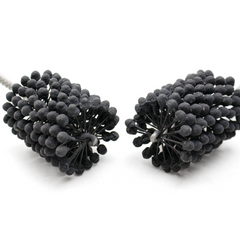
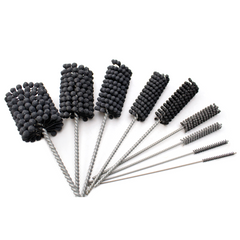
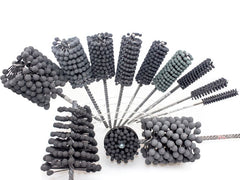
Our silicon carbide grit ball hone is manufactured from silicon carbide grit balls on bristles and engineered for cylinder deburring plateau honing, with key advantages including self-centering and self-aligning, uniform cross-hatch pattern and soft cutting action.
Also known as SiC grit ball hone, custom silicon carbide grit ball hone or industrial ball hone.
Specifications and Custom Sizes
Silicon Carbide Ball Hone Specifications
Reference Drawing:

| Dia A | Working l. B | Shaft D. C | Total l. D | Part No. |
|---|---|---|---|---|
| SC 120# | ||||
| 4 | 40 | 1.8 | 200 | QS1240004 |
| 5 | 50 | 2.2 | 200 | QS1250005 |
| 6 | 50 | 2.2 | 200 | QS1250006 |
| 8 | 50 | 3 | 200 | QS1250008 |
| 10 | 50 | 3.3 | 200 | QS1250010 |
| 12 | 50 | 3.6 | 200 | QS1250012 |
| 14 | 50 | 3.6 | 200 | QS1250014 |
| 20 | 60 | 4.1 | 200 | QS1260020 |
| 22 | 70 | 4.5 | 200 | QS1270022 |
| 24 | 70 | 4.5 | 200 | QS1270024 |
| 26 | 70 | 5 | 200 | QS1270026 |
| 28 | 70 | 5.2 | 200 | QS1270028 |
| 30 | 70 | 5.2 | 200 | QS1270030 |
| 32 | 70 | 5.2 | 200 | QS1270032 |
| 34 | 70 | 5.6 | 200 | QS1270034 |
| 36 | 70 | 5.6 | 200 | QS1270036 |
| 38 | 70 | 5.6 | 200 | QS1270038 |
| 40 | 70 | 6 | 200 | QS1270040 |
| 50 | 70 | 6 | 200 | QS1270050 |
| 60 | 70 | 6.5 | 200 | QS1270060 |
| 70 | 70 | 6.5 | 200 | QS1270070 |
| 80 | 80 | 8 | 300 | QS1280080 |
| 90 | 80 | 8 | 300 | QS1280090 |
| 100 | 80 | 8 | 300 | QS1280100 |
| 105 | 80 | 8 | 300 | QS1280105 |
Material Composition
This brush is built from 2 material groups – the durable nylon filaments and steel shank (twisted wire stem):
- Filament Material: Durable nylon filaments with permanently attached silicon carbide (SiC) abrasive balls
- Handle/Core Material: Steel shank (twisted wire stem)
Features and Applications
Dingle Ball Hone
The flexible ball hone, also known as a ball hone or Flex Hone style tool.Colloquially, some people also refer to the tool as a dingleberry hone, cylinder hone,grape hone, bead hone, bottle brush hone, glaze buster/breaker hone, or flexible hone. Is a resilient, self-centering cylinder honing tool designed for precision bore finishing, deglazing, and cross-hatch pattern generation. Its unique construction – abrasive globules permanently mounted on flexible nylon filaments – provides a soft-cutting action that removes peaks from previous machining operations while retaining oil-holding valleys . This process, known as plateau finishing, creates an optimized cylinder wall surface that promotes proper piston ring seating, reduces friction, and extends engine life .
- Self-centering and self-aligning – flexible filaments automatically center the tool within the bore, compensating for slight misalignment or ovality
- Uniform cross-hatch pattern – creates consistent 45° oil-retaining grooves essential for proper lubrication and ring sealing
- Soft cutting action – removes loose, torn, or folded metal without altering critical bore geometry or damaging thin coatings
- Versatile application – suitable for cast iron, aluminum, Nikasil-plated cylinders, brake cylinders, hydraulic components, and more
- No special training required – compatible with standard drill presses and handheld power tools
Ball Hone for Cylinder Deburring Plateau Honing
- Automotive engine rebuilding – cylinder deglazing, cross-hatch restoration, and plateau finishing
- Motorcycle and small engine repair – Nikasil cylinder deglazing and surface conditioning
- Hydraulic cylinder maintenance – bore cleaning and surface refinement for seal longevity
- Brake cylinder restoration – deglazing master cylinders, wheel cylinders, and caliper bores
-
Industrial manufacturing – deburring cross-drilled holes, edge blending, and surface conditioning on precision bores
In practice the same brush is specified as dingle ball hone cylinder depending on the application.
Frequently Asked Questions (FAQ)
Q1: How do I select the correct flexible ball hone diameter for my cylinder?
Flexible hones are supplied in an oversized condition and should be ordered by the nominal bore diameter. Select the standard size that matches your cylinder bore (8mm to 20mm). If your bore size falls between two standard diameters, choose the larger size for proper filament contact and effective cross-hatch generation .
Q2: What grit size should I choose for my application?
Grit selection depends on your material and desired surface finish. For deglazing cast iron engine cylinders, use silicon carbide (SiC) abrasive. For Nikasil-plated cylinders, aluminum oxide (AO) is recommended. Lower grits provide more aggressive material removal; higher grits produce finer finishes. Most engine rebuilding applications use 180-320 grit .
Q3: Can this brush be used on Nikasil cylinder coatings?
Yes, aluminum oxide (AO) flexible hones can be used to deglaze Nikasil cylinders in good condition without damage. However, inspect the cylinder first – if the plating is chipped, worn, or showing visible damage, the cylinder should be re-plated or replaced rather than honed .
Q4: What operating speed and technique should I use?
Flexible hones are low-RPM tools. For standard diameters (4" to 7.5"), recommended speeds are 350-600 RPM. Use a variable-speed drill with adequate power. Stroke rate determines cross-hatch angle – higher stroke rates produce larger angles. Always use honing oil or cutting fluid for lubrication and to prevent tool loading .
Q5: How do I clean the cylinder after honing?
After honing, thoroughly clean the cylinder walls with soap, water, and a bristle brush to remove all abrasive residue. Wipe dry with a clean cloth, then lightly oil the surface to prevent rust. Proper cleaning is essential to ensure piston ring seating and prevent abrasive contamination .
Ready to Optimize Your Cylinder Finishing Operations?
Our flexible ball hone are available in standard diameters from 8mm to 20mm, with custom sizes available upon request. Each tool is engineered for consistent cross-hatch generation, plateau surface finishing, and extended service life.
Contact us for technical recommendations, custom sizing, and bulk order quotes. Provide your bore diameter, material type, and surface finish requirements for a prompt engineering review.
For the full selection of flexible abrasive honing tools, browse our flexible honing tool range .
Browse our full Tube Brush Series for additional internal finishing solutions, or explore our custom industrial brushes for other specialized applications.
Related Categories
- Choosing a selection results in a full page refresh.