



Product Overview
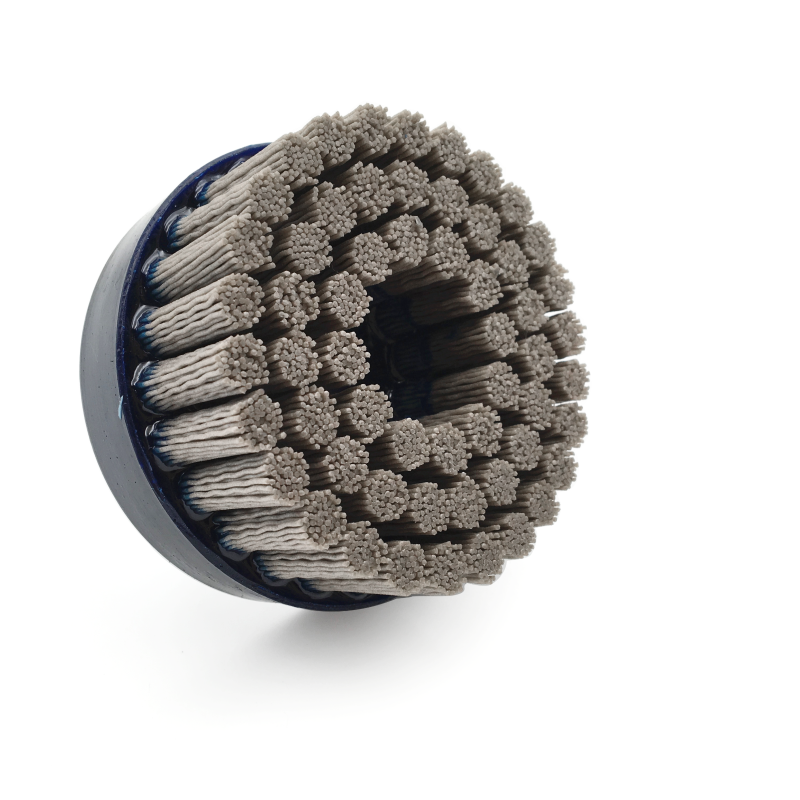
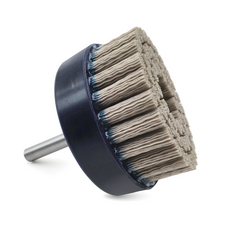
Our aluminum oxide tufted ring cluster disc brush is manufactured from aluminum oxide abrasive nylon and engineered for cnc deburring, with key advantages including superior chip evacuation and heat dissipation, flexible buffering with low over-cutting risk and extended service life.
Also known as AO tufted ring cluster disc brush, custom aluminum oxide tufted ring cluster disc brush or industrial disc brush.
Specifications and Custom Sizes
Custom Aluminum Oxide Disc Brush Sizes and Grits
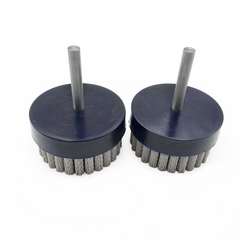
Customizable according to customer requirements – disc diameter, trim length, cluster configuration, and shank size fully tailored to match specific workpiece geometries and equipment specifications. Standard shank diameters: 6mm and 8mm for direct mounting in CNC machining centers, milling machines, and robotic spindles .
Material Composition
This brush is built from 2 material groups – the aluminum oxide and steel shank:
- Filament Material: Aluminum oxide (Al₂O₃ / white fused alumina) abrasive nylon filament – moderate hardness with balanced, uniform cutting action . Ideal for deburring and finishing without scratching precision surfaces . Available in various grit sizes to match specific material and finish requirements .
- Shank / Base Material: Steel shank with tufted cluster construction – individual fan-shaped filament tufts are point-anchored to the disc base in a clustered arrangement (distinct from full-face cast designs). Standard cylindrical shank for direct collet mounting in CNC spindles, with no additional fixtures required .
Features and Applications
Aluminum Oxide Disc Brush
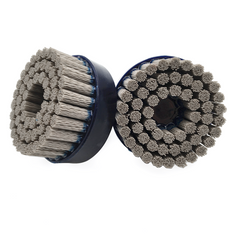
Our Tufted Cluster Shank-Mounted Aluminum Oxide Abrasive Filament Disc Brush features a segmented tufted cluster construction where individual fan-shaped filament tufts are independently anchored to the steel disc base. This design – also known as a clustered solid end brush, multi-tuft shank-mounted abrasive brush, or CNC cluster deburring brush – provides superior chip evacuation, flexible buffering, and extended service life compared to full-face cast designs .
Core Advantages:
- Superior Chip Evacuation and Heat Dissipation – gaps between individual filament clusters allow machining chips and heat to escape rapidly, preventing workpiece burning and enabling continuous high-speed machining
- Flexible Buffering with Low Over-Cutting Risk – independent cluster blocks provide elastic compliance, adapting to workpiece dimensional variations and preventing gouging on edges, corners, and cross-hole intersections
- Extended Service Life – Localized Wear Without Total Failure – individual cluster wear does not render the entire brush unusable; remaining clusters continue to function effectively
- Balanced, Gentle Cutting Action – aluminum oxide abrasive provides moderate hardness with uniform cutting force, effectively deburring while minimizing the risk of scratching precision workpiece surfaces
- Ready-to-Mount Design – standard cylindrical shank allows direct collet mounting in CNC machining centers, milling machines, and robotic spindles without additional fixtures, suitable for automated batch production
- Secure Filament Retention – each filament tuft is securely bonded at the base, preventing filament loss even during high-speed rotation
Aluminum Oxide Ring Cluster Disc Brush for CNC Deburring
Automotive Parts Manufacturing:
- Transmission housings, aluminum cylinder heads, valve bodies, and compressor housings – deburring and surface finishing
- Cross holes, stepped end faces, and threaded ports – removing rolled burrs and sharp edge chamfering
Hydraulic Valve Body Industry:
- Valve block cross-hole ports and oil passage ports – deburring and removing machining flash from intersecting holes
General CNC Machining:
- Aluminum, copper, and cast iron components – deburring part end faces, cavity steps, and removing machining marks
- Edge softening of precision stampings and machined parts without damaging finished surfaces
Die-Casting Industry:
- Aluminum die-cast parts – parting line cleaning, gate mark removal, and light chamfering
Automated Robotic Finishing:
- Robotic spindle deburring – ideal for high-volume, flexible deburring operations in automated cells
Material Compatibility:
- Aluminum and aluminum alloys – suitable
- Copper and copper alloys – suitable
- Cast iron – conditionally suitable
- Steel (tensile strength < 900 N/mm²) – conditionally suitable

Frequently Asked Questions (FAQ)
Q1: What is the advantage of the tufted cluster design over full-face cast disc brushes?
The tufted cluster design provides gaps between individual filament tufts for superior chip evacuation and heat dissipation, preventing workpiece burning during continuous high-speed operation . The independent cluster blocks also offer flexible buffering that adapts to workpiece variations, reducing the risk of over-cutting . Additionally, localized cluster wear does not render the entire brush unusable – remaining clusters continue to function effectively, extending overall service life.
Q2: Why choose aluminum oxide (AO) abrasive over silicon carbide (SiC)?
Aluminum oxide provides moderate hardness with balanced, uniform cutting force . It is ideal for deburring and finishing aluminum, copper, and other non-ferrous metals without scratching precision surfaces. While silicon carbide offers more aggressive cutting for ferrous metals and heavy rust removal, AO is the preferred choice for applications requiring gentle, controlled material removal .
Q3: Is this brush suitable for automated CNC and robotic applications?
Yes. The standard cylindrical shank allows direct collet mounting in CNC machining centers, milling machines, and robotic spindles without additional fixtures . The brush can be used in the same tool changer as cutting tools, enabling deburring and finishing operations immediately after machining in the same setup . This eliminates secondary operations and reduces manual labor .
Q4: What is the recommended operating speed for this brush?
Recommended speed is typically 1,500–2,800 min⁻¹, with maximum speed up to 4,500 min⁻¹ depending on brush diameter. Feed rate should be 800–3,000 mm/min with infeed of 0.3mm (fine) to 2.0mm (coarse). Always start at lower speeds and increase gradually. For aluminum parts, 2,000 RPM is recommended; for stainless steel, 1,800 RPM .
Q5: How do I select the correct grit size for my application?
Grit selection depends on your material and desired finish. Coarse grit (46–80) provides aggressive material removal for heavy burrs . Medium grit (120–180) is suitable for general deburring and edge blending. Fine grit (240–320) delivers precision finishing and surface refinement . Contact our engineering team with your specific material and application requirements for optimal grit recommendations.
Ready to Automate Your Deburring and Surface Finishing Operations?
Our tufted cluster shank-mounted aluminum oxide abrasive filament disc brushes combine the balanced cutting power of AO abrasive with the chip-evacuation benefits of tufted cluster design and the convenience of direct shank mounting. Available with customizable disc diameters, trim lengths, cluster configurations, and shank sizes to match your specific CNC deburring, edge finishing, and surface conditioning requirements.
Contact us for technical recommendations, custom sizing, and bulk order quotes. Provide your application details, workpiece material, and equipment specifications for a prompt engineering review.
Browse our full Disc Brush Series for additional surface finishing solutions, or explore our custom industrial brushes for other specialized requirements.
Related Categories
- Choosing a selection results in a full page refresh.