





- Choosing a selection results in a full page refresh.
LONGGUANG currently has more than 3,000 industrial brush products, covering all industries such as auto parts, mechanical parts, hydraulic parts, etc. Our products are widely used in the polishing, de-rusting, and deburring of metal parts processing; metal sheet, strip cleaning, grinding, descaling; finishing of textile, printing, and dyeing leather products, sanding; dust removal, grinding and coating of paper and artificial boards Glue; cleaning, polishing, deburring of circuit boards; cleaning of glass and LCD substrates; cleaning and descaling of pipes; sealing and dust proofing of furniture, storage, and machinery.
Couldn't load pickup availability
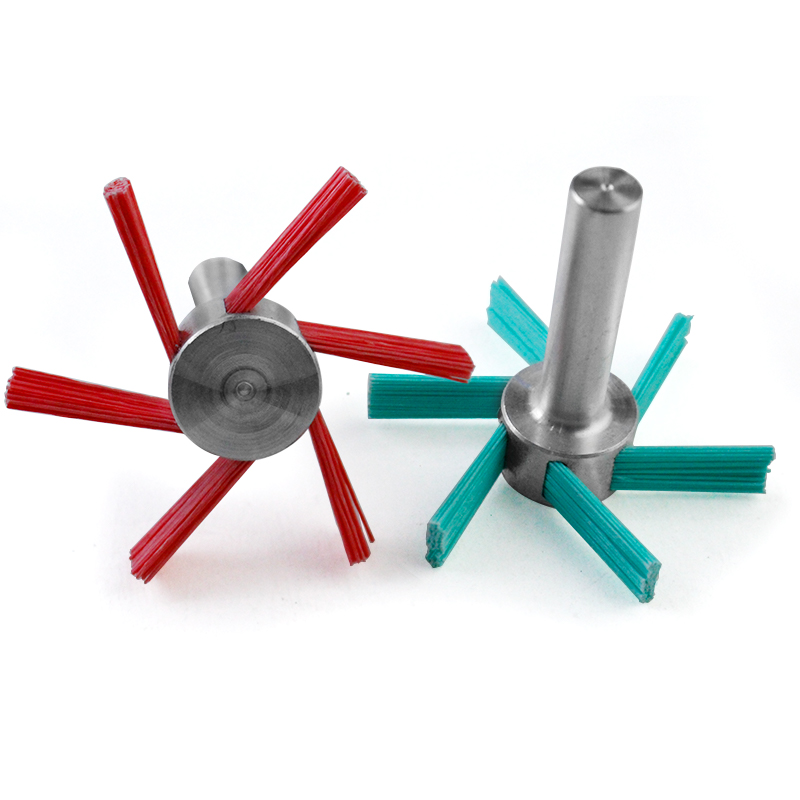
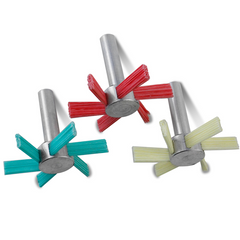
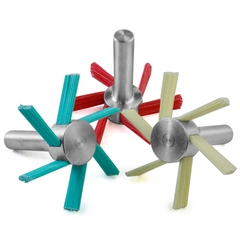
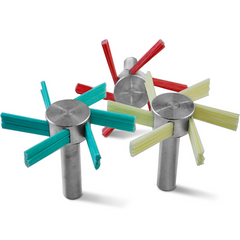
Our ceramic fiber radial disc brush is manufactured from ceramic fiber (red/teal) and engineered for cross-hole radial deburring, with key advantages including star-shaped radial filament structure, ceramic fiber material properties and self-sharpening performance.
Also known as custom ceramic fiber radial disc brush, industrial disc brush or disc brush for cross-hole radial deburring.
Customizable according to customer requirements – brush diameter, filament length, shank diameter, and overall length fully tailored to match specific hole sizes and workpiece geometries. Standard shank diameters available for direct mounting in CNC machining centers, electric spindles, and power tools.
This brush is built from 2 material groups – the ceramic fiber and steel straight shank:
Our Star-Shaped Mounted Ceramic Fiber Brush features a unique radial star-shaped filament arrangement where multiple ceramic fiber bundles radiate outward from the steel shank base in a star configuration. This design – also known as a star-type ceramic fiber brush, cross-hole ceramic deburring brush, or radial fan-blade mounted brush – provides 360° multi-directional deburring action that reaches internal hole walls, cross-hole intersections, and bore edges that standard end-face brushes cannot access .
Core Advantages:
Ceramic Fiber vs. Ceramic Abrasive (Grit) Filament:
| Feature | Ceramic Fiber (This Product) | Ceramic Abrasive (Grit) Filament |
|---|---|---|
| Cutting mechanism | Fiber tips act as cutting edges | Embedded abrasive grit |
| Grinding power | Consistent throughout brush life | Declines with grit loss |
| Deformation resistance | Excellent – maintains shape | Moderate |
| Material hardness capability | Up to 65 HRC | Moderate |
| Best for | Precision deburring, cross-hole finishing | General deburring, surface finishing |
Q1: What is the difference between ceramic fiber brushes and ceramic abrasive (grit) filament brushes?
Ceramic fiber brushes use thousands of micro-ceramic fibers as cutting edges – each filament consists of approximately 1,000 individual fibers that act as cutting tools . They provide consistent grinding power throughout the brush's life with no deformation. Ceramic abrasive (grit) filament brushes rely on embedded abrasive particles that wear and lose effectiveness over time. Ceramic fiber brushes are the world's first practical application of this technology for CNC deburring .
Q2: What is the advantage of the star-shaped radial filament arrangement?
The star-shaped radial arrangement allows filaments to reach internal hole walls, cross-hole intersections, and bore edges that standard end-face brushes cannot access. During rotation, filaments act 360° on the workpiece, simultaneously cleaning hole entry faces and internal bore walls – particularly effective for cross-hole intersection deburring.
Q3: Can this brush be used on aluminum, copper, or other non-ferrous metals?
Yes. Ceramic fiber brushes produce no metallic residue and will not cause iron contamination on non-ferrous metals. The flexible fibers provide gentle cutting action that will not scratch or gouge soft materials, making them ideal for aluminum, copper, brass, and other non-ferrous alloys.
Q4: Is this brush suitable for automated CNC and robotic applications?
Yes. The standard cylindrical shank allows direct collet mounting in CNC machining centers, electric spindles, and robotic arms . The brush can be used in the same tool changer as cutting tools, enabling deburring and finishing immediately after machining . The consistent performance and no-deformation characteristics make it ideal for high-volume automated production.
Q5: What is the recommended operating speed and technique?
Recommended speed depends on brush diameter and application. Typical speeds range from 1,500–3,000 min⁻¹ for most applications. When deburring cross-holes, the brush should be rotated while being inserted and withdrawn – the ceramic fibers will self-adapt to the hole geometry. Always start at lower speeds and increase gradually. Coolants and lubricants are recommended for extended service life.
Our star-shaped mounted ceramic fiber brushes combine the superior cutting power of ceramic fiber technology with the 360° multi-directional action of radial star-shaped filament arrangement. Available with customizable brush diameters, filament lengths, shank diameters, and overall dimensions to match your specific internal hole, cross-hole, and precision deburring requirements.
Contact us for technical recommendations, custom sizing, and bulk order quotes. Provide your application details, workpiece material, and equipment specifications for a prompt engineering review.
Browse our full Tube Brush Series for additional internal finishing solutions, or explore our Ceramic Fiber Brush Series for other precision finishing requirements.
Thanks for subscribing!
This email has been registered!