


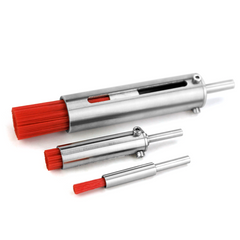


Product Name:
Ceramic Fiber Disc Brush - Sleeve Type
Product Size:
Customizable according to customer requirements
Refference Drawing:
Sleeve

Brush

Standard Series:
Sleeve
| Dia A | Shaft D. C | Shaft l. D | Total l. E | Item No. |
| Stainless Steel | ||||
| 10 | ф6 | 30 | 70 | TM702010-01 |
| 18 | ф6 | 30 | 100 | TM702018-01 |
| 30 | ф8 | 30 | 150 | TM702030-01 |
| 45 | ф10 | 30 | 150 | TM702045-01 |
| 65 | ф12 | 40 | 160 | TM702065-01 |
| 110 | ф16 | 40 | 160 | TM702110-01 |
| 135 | ф16 | 40 | 160 | TM702135-01 |
Brush
| Dia A | Thickness B | Trim l. C | Bundle D. D | Bundle Count | Part No. |
| Ceramic Fiber | |||||
| 8 | 12 | 30 | ф6 | 1 | TM702010-02 |
| 15 | 15 | 50 | ф3 | 8 | TM702018-02 |
| 25 | 25 | 75 | ф4 | 12 | TM702030-02 |
| 40 | 25 | 75 | ф5 | 16 | TM702045-02 |
| 60 | 25 | 75 | ф6 | 22 | TM702065-02 |
| 100 | 25 | 75 | ф6 | 38 | TM702110-02 |
| 125 | 25 | 75 | ф6 | 40 | TM702135-02 |
Material Composition:
-
Filament Material: Proprietary high-performance ceramic fiber filaments
-
Handle/Hub Material: Durable metal sleeve (hub) with replaceable brush head design
Product Features:
-
Adjustable filament exposure length – allows operators to fine-tune brush stiffness, aggressiveness, and reach for specific tasks from aggressive blending to delicate final polishing
-
Two-component innovative design – features a durable metal sleeve (hub) and a replaceable ceramic fiber brush head for maximum versatility and cost efficiency
-
Exceptional cutting speed – proprietary ceramic fiber filaments deliver superior cutting performance on challenging materials
-
Consistent results – maintains uniform finishing quality throughout brush life
-
Long service life – replaceable brush head design extends hub life while maintaining performance
-
High temperature resistant & wear resistant – ideal for demanding precision finishing applications
-
No bristle loss & falling off – safe for critical components
-
Scratch-free treatment – achieves flawless finishes without damaging workpiece integrity
Applicable Scenarios:
-
Tool & die making – from aggressive blending to delicate final polishing on hardened tool steels
-
Precision aerospace component processing – finishing critical turbine components and engine parts
-
Metal mold cleaning & grinding – adjustable exposure for accessing complex mold geometries
-
Metal parts surface treatment – adaptable for both rough and fine finishing on the same workpiece
-
Aerospace alloy parts processing – achieving flawless finishes on superalloys like Inconel and Titanium
-
High-value application requiring adaptable and repeatable results – perfect for CNC automated finishing cells

What Makes Sleeve-Type Ceramic Fiber Disc Brushes Different?
Our Ceramic Fiber Disc Brushes with an integrated sleeve system offer superior versatility and control for precision surface finishing. This innovative two-component design features a durable metal sleeve (hub) and a replaceable ceramic fiber brush head.
The key advantage is the adjustable filament exposure length – a feature that sets this brush apart from standard disc brushes. By simply adjusting how far the ceramic fiber filaments extend from the sleeve, operators can fine-tune the brush's stiffness, aggressiveness, and reach to match specific tasks. Need aggressive material removal? Expose more filament length for greater flexibility and cutting action. Require delicate final polishing? Reduce exposure for a stiffer, more controlled finish.
Equipped with our proprietary high-performance ceramic fiber filaments, this brush delivers exceptional cutting speed, consistency, and longevity on challenging materials. It is the ideal solution for achieving flawless finishes in tool & die making, precision aerospace component processing, and any high-value application requiring adaptable and repeatable results.
Adjustable Exposure: One Brush, Multiple Applications
| Exposure Setting | Stiffness | Aggressiveness | Best For |
|---|---|---|---|
| Longer exposure | More flexible | Higher | Aggressive blending, contour following, material removal |
| Shorter exposure | Stiffer | Controlled | Delicate polishing, edge radiusing, final finishing |
Comparison: Sleeve Type vs. Standard Disc Brush
| Feature | Sleeve Type (This Product) | Standard Disc Brush |
|---|---|---|
| Filament exposure | Adjustable | Fixed |
| Versatility | Multiple tasks with one brush | One task per brush |
| Hub reusability | Yes (replaceable brush head) | No (disposable) |
| Cost efficiency | High (hub lasts through multiple heads) | Moderate |
| Ideal for | CNC cells, job shops, multi-step processes | Dedicated single operations |
Related Products You May Need:
-
For standard ceramic fiber disc applications, see our Resin Injection Ceramic Fiber Disc Brush
-
Explore other disc brush options: Resin Injection Disc Brush - Full Face Type and Resin Injection Disc Brush - Equal Divide Type
-
For end brush applications on complex geometries, see Ceramic Fiber End Brush
-
Browse the complete Ceramic Fiber Brush Series
-
Explore the full Disc Brush Series
Why Choose Sleeve-Type for Your CNC Finishing Cell?
In automated finishing operations, tool change time directly impacts productivity. The adjustable exposure design of our sleeve-type brush allows operators to perform multiple finishing steps – from aggressive blending to final polishing – using the same tool setup, simply by adjusting filament exposure. This reduces tool changes, minimizes programming complexity, and improves overall cell efficiency.
Furthermore, when the ceramic fiber filaments eventually wear down, only the replaceable brush head needs to be discarded. The durable metal sleeve (hub) remains in service, reducing consumable costs and waste – a significant advantage for high-volume production environments.
Customization Available
We offer custom diameters, filament grit sizes, and sleeve configurations to match your specific CNC spindle requirements. Contact us for technical recommendations.
Frequently Asked Questions (FAQ)
Q1: What is the main benefit of the sleeve system compared to a fixed-head brush?
A: The primary benefit is adjustability. In precision machining, one size rarely fits all. The sleeve allows you to "dial in" the exact amount of bristle stiffness required for your specific material and part geometry, ensuring repeatable results that fixed brushes cannot match.
Q2: How do I adjust the filament exposure length?
A: The sleeve system is designed for quick adjustments. By loosening the securing mechanism on the hub, you can slide the ceramic fiber head to the desired protrusion length and re-tighten. This allows the same tool to transition from aggressive material removal to fine finishing.
Q3: Can these replaceable heads handle high-hardness materials?
A: Yes. Our proprietary ceramic fibers are designed to effectively process materials with hardness ratings up to HRC 65. They are particularly effective on hardened steels, ceramics, and advanced composites.
Q4: Is this system compatible with standard CNC tool holders?
A: Absolutely. The metal sleeve features a standard straight shank that is compatible with ER collets, milling chucks, and other standard CNC tool-holding systems, making it easy to incorporate into your existing tool library.
Q5: When should I replace the ceramic fiber head?
A: You should replace the head once the filaments have been worn down to their minimum usable length (as dictated by the sleeve's depth). Because the cutting action is concentrated at the tips, the performance remains consistent until the very end.
- Choosing a selection results in a full page refresh.