







Product Name:
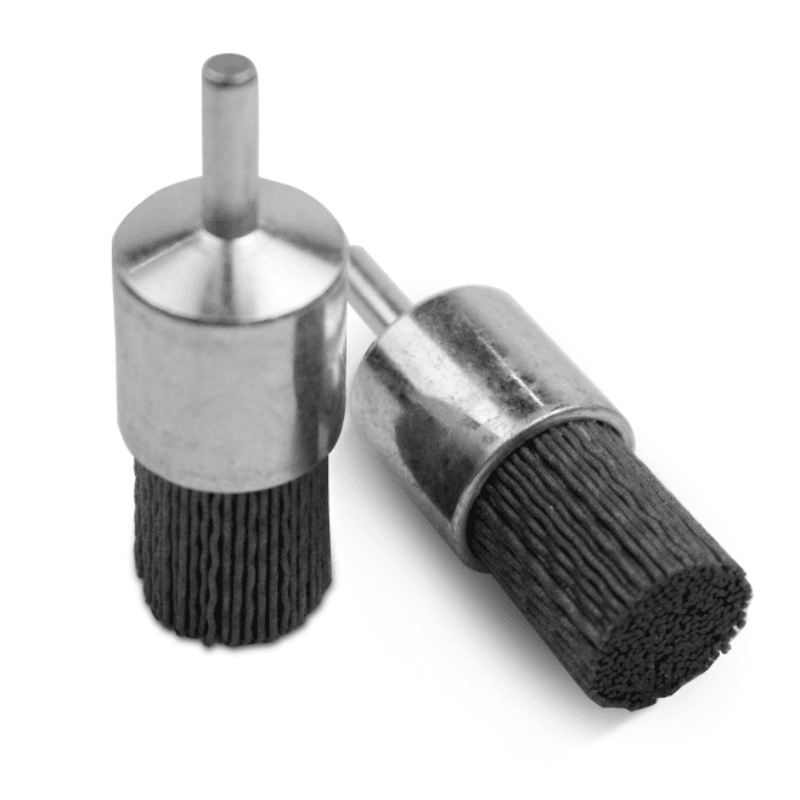
Silicon Carbide Abrasive Nylon Filament End Brush – Precision Deburring and Surface Finishing Tool
Product Size:
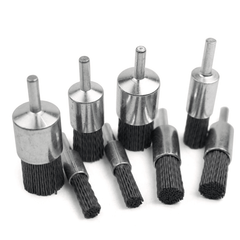
Customizable according to customer requirements – brush diameter, trim length, and shank size fully tailored to match specific bore sizes and workpiece geometries.
Refference Drawing:

Standard Series:
| Dia A | Trim B | Shaft D. C | Shaft l. D | Total l. E | Part No. |
| SC 120# | |||||
| 10 | 25 | 6 | 18 | 63 | BS122510 |
| 12 | 25 | 6 | 21 | 66.5 | BS122512 |
| 14 | 25 | 6 | 17 | 67 | BS122514 |
| 16 | 25 | 6 | 23 | 75 | BS122516 |
| 18 | 25 | 6 | 23 | 71 | BS122518 |
| 20 | 25 | 6 | 22 | 70 | BS122520 |
| 25 | 25 | 6 | 20 | 72 | BS122525 |
| 29 | 25 | 6 | 18 | 73 | BS122529 |
| • Various grit sizes of abrasive brush filaments are available upon request; standard sizes include 120#, 180#, 240#, and 320#. • Various types of abrasive grains are available upon request; standard types include aluminum oxide, silicon carbide, ceramic, and diamond. |
|||||
Product Material Composition:
-
Filament Material: High-temperature resistant Nylon 6.12 filaments with uniformly embedded silicon carbide (SiC) abrasive micro-particles – self-sharpening, non-shedding, excellent toughness with slight yielding action to prevent workpiece damage
-
Shank Material: Steel shank for secure mounting in CNC machining centers, drill presses, and handheld power tools
Product Features and Applications:
Our Silicon Carbide Abrasive Nylon Filament End Brush features high-temperature resistant Nylon 6.12 filaments uniformly embedded with silicon carbide (SiC) micro-particles. This construction delivers cutting power between pure nylon brushes and wire brushes – capable of precision micro-grinding, deburring, and edge radiusing without generating metallic debris or iron ion contamination.
Key Features:
-
Balanced Cutting Power – cutting action between nylon and wire brushes, suitable for precision micro-grinding, deburring, and edge radiusing applications
-
Self-Sharpening Action – SiC particles continuously expose new cutting edges during use, providing significantly longer service life than standard nylon brushes
-
Zero Contamination – no metallic debris, no iron ion contamination; will not scratch mirror-finished, anodized aluminum, or coated surfaces
-
Non-Marring Flexibility – slight yielding action prevents gouging or damage to workpiece reference surfaces
-
Chemical Resistance – resistant to cutting fluids, cleaning solutions, and mild acid/alkali immersion; will not rust or corrode
-
End-Face Configuration – flat brush face suitable for hole entrances, step surfaces, counterbores, and flat surface micro-finishing
-
Excellent Thermal Stability – Nylon 6.12 base offers good wet/dry hardness retention compared to standard nylon materials
Application Fields:
-
Precision Internal and Hole-Entry Deburring – deburring bore entrances, micro edge radiusing, and finishing internal passages
-
Aluminum Die-Casting and New Energy Housings – precision finishing of aluminum alloy castings, battery housings, and EV component enclosures
-
3C Electronics Precision Metal Parts – deburring and surface conditioning of electronic device housings and precision components
-
Mold and Die Cleaning and Polishing – cleaning and surface refinement of plastic molds, rubber molds, and die surfaces
-
Hydraulic and Pneumatic Precision Components – deburring and finishing of valve bodies, valve blocks, and manifold passages
-
Stainless Steel, Copper, and Titanium Alloy Finishing – post-processing of precision components without cross-contamination
-
Pre-Treatment for Coating, Electroplating, and Anodizing – surface preparation for subsequent finishing operations
-
CNC Automation Integration – designed for automated batch processing on CNC machining centers
Limitations: Not suitable for thick weld slag, heavy oxidation, or large flash removal – this brush is engineered for precision micro-finishing applications only.
Nylon 6.12 Advantage: Nylon 6.12 offers lower moisture absorption and better dimensional stability compared to Nylon 6 or Nylon 66, maintaining consistent filament hardness in wet processing conditions.

Frequently Asked Questions (FAQ)
Q1: What is the difference between SiC abrasive nylon brushes and standard nylon brushes?
SiC abrasive nylon brushes have silicon carbide particles uniformly embedded in the nylon filaments, providing self-sharpening cutting action for precision deburring and micro-grinding. Standard nylon brushes have no abrasive content and are suitable only for cleaning and dust removal.
Q2: Can this brush be used on anodized aluminum without damaging the surface?
Yes, the non-metallic abrasive filaments will not scratch anodized, coated, or mirror-finished aluminum surfaces. The flexible nylon filaments provide a yielding action that prevents gouging while effectively removing burrs.
Q3: What is the advantage of Nylon 6.12 material over Nylon 6 or Nylon 66?
Nylon 6.12 offers significantly lower moisture absorption and better dimensional stability than Nylon 6 or Nylon 66. This means the filaments maintain consistent hardness and cutting performance in wet machining environments and when exposed to cutting fluids.
Q4: What operating speed should I use for this brush?
For optimal performance, operate at recommended speeds based on brush diameter. As a general guideline, use lower speeds (500-1500 RPM) for larger diameters and higher speeds for smaller diameters. Always start at lower speeds and increase gradually. When deburring, only the filament tips should contact the workpiece – excessive pressure does not improve results but reduces brush life.
Q5: How do I select the correct brush diameter for my application?
Select a brush diameter that provides adequate filament contact with the bore or workpiece surface – typically approximately 10-20% larger than the bore diameter for internal applications. The nylon filaments will compress and conform to the workpiece during operation. Contact our engineering team with your specific workpiece specifications for precise sizing recommendations.
Ready to Improve Your Precision Deburring and Surface Finishing Operations?
Our silicon carbide abrasive nylon filament end brushes are available with customizable diameters, trim lengths, and shank configurations to match your specific precision deburring and finishing requirements.
Contact us for technical recommendations, custom sizing, and bulk order quotes. Provide your application details, workpiece material, and equipment specifications for a prompt engineering review.
Browse our full End Brush Series for additional deburring and finishing solutions, or explore our custom industrial brushes for other specialized requirements.
- Choosing a selection results in a full page refresh.